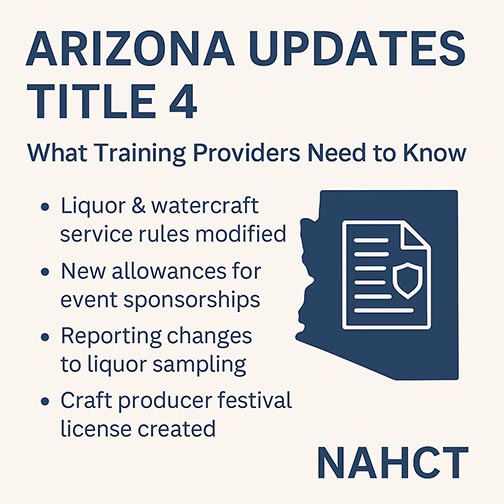
The Arizona Department of Liquor Licenses and Control (DLLC) has announced updates to Title 4, with new provisions taking effect September 26, 2025. Training providers must review these changes and submit updated syllabi, exams, and course materials to the DLLC by September 15, 2025.
Below is a breakdown of the main legislative updates, what they mean, and how you may need to adjust your curriculum.
SB1467 – Liquor & Watercraft
What Changed:
- Liquor service and consumption rules for government-owned docks and boats have been modified.
- Hours for alcohol service on boats are now limited to 9:00 a.m. to 11:00 p.m.
- Some food-service requirements tied to government licenses have been removed.
What It Means for Training:
Unless you cover alcohol service on boats or government-operated venues, you may not need to add this to your general server training. It’s useful context for some learners, but most providers will only need to note that rules for watercraft exist without making it a core focus of the course.
SB1736 – Amusements and Sponsorships
What Changed:
- Liquor producers and wholesalers can now sponsor and advertise at certain concerts held at temporarily extended licensed premises.
- This only applies if the event space holds more than 1,000 people and is adjacent to a multipurpose facility.
- This allowance runs through June 30, 2027 and ends on January 1, 2028.
What It Means for Training:
If your training covers special events or temporary extensions of premises, you should mention this change. Staff need to understand that advertising and sponsorship at large concerts is now allowed in limited situations—but it’s temporary and will expire in 2028.
HB2741 – Liquor Sampling and Reporting
What Changed:
- Beer, wine, and liquor stores with sampling privileges no longer have to use the DLLC’s single reporting system.
- Stores can now use any reasonable method (spreadsheets, point-of-sale software, or internal tracking systems) to keep records.
- Licensees must still report their upcoming samplings to DLLC every two weeks, but the format is more flexible.
What It Means for Training:
When teaching about alcohol sampling:
- Make clear that stores must maintain records and report regularly.
- But now they have flexibility in how they do it—they don’t have to log into one mandatory DLLC platform.
- For learners, this means they may encounter different systems depending on where they work, and they must follow their employer’s process.
HB2905 – Craft Producer Festival & Fair License
What Changed:
- Arizona has created a single Craft Producer Festival License, replacing separate wine, craft distillery, and microbrewery festival licenses.
- With this license, craft producers can:
- Offer samples of their products at festivals and fairs.
- Sell products for on- or off-premises consumption.
- Have representatives taste products on site for quality control.
- Each craft producer can operate under this license for up to 150 event days per year.
- The DLLC can also issue a special event license at the same time if needed.
- Importantly, this change repeals the older festival licenses and consolidates everything into this new license.
What It Means for Training:
This is one of the most important updates for trainers. If your curriculum covers festivals, fairs, or special events, you’ll need to update it:
- Replace references to the old wine, distillery, or microbrewery festival licenses with the new Craft Producer Festival License.
- Clarify that these licenses allow both sampling and sales.
- Reinforce that while festival rules may change, staff responsibilities—ID checks, preventing overservice, and safe service—remain the same.
What You Should Do Next
- Review and update your training materials to reflect these changes, especially in sections about sampling, special events, and festivals.
- Submit your revised syllabus, exam, and course content electronically to DLLC by September 15, 2025 (hard copies are not accepted).
- Educate your learners by explaining these changes in simple, practical terms. For example: “You may see different systems for sampling recordkeeping now” or “Festivals now use one license type instead of three.”
Final Note
Not all of these updates will require major changes to your course content. For many providers, the most impactful updates are in the areas of sampling flexibility and the new craft producer festival license.
Even when the law allows for new opportunities, remember to stress to learners that their core duties remain unchanged: check IDs, prevent overservice, and always ensure alcohol is being served responsibly.
Disclaimer
The information presented in this blog was prepared by the National Association of Hospitality Compliance Trainers (NAHCT) as a summary to assist training providers in staying informed about compliance updates. While every effort has been made to provide accurate information, NAHCT is not responsible for any errors, omissions, or misinterpretations. Each training provider is responsible for reviewing the official statutes, regulations, and guidance from the appropriate regulatory authority to ensure their curriculum is accurate and compliant.