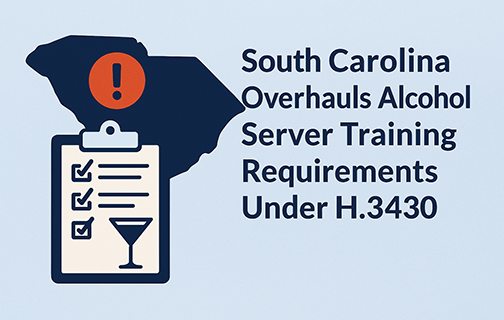
On May 12, 2025, South Carolina enacted H.3430, a sweeping liquor liability reform and alcohol server certification law. This new law represents a complete shift in how alcohol server training is regulated in the state, and it directly impacts training providers, licensees, and employees working in on-premises establishments.
What’s Changed?
Previously, a number of training programs were recognized by the South Carolina Department of Revenue (SCDOR) for educating alcohol enforcement. However, under H.3430, those previously recognized programs are no longer approved. All training providers must now reapply and receive approval under the new requirements.
This means that only SCDOR-approved programs will qualify servers for certification going forward. Programs that were once considered valid under the Department of Revenue’s recognition list will not satisfy the new law unless they go through the updated review and approval process.
Certification Process for Providers
Training providers must submit their programs to the SCDOR for review at ABL@dor.sc.gov. Approval will be determined by a review team consisting of the:
- South Carolina Department of Revenue / Alcohol Beverage Licensing (SCDOR/ABL)
- South Carolina Department of Behavioral Health Services (SCDBH)
- South Carolina Law Enforcement Division (SLED)
Providers must supply login credentials for five reviewers if the program is delivered online. The review process may take up to 60 days, and providers will receive a written notice of approval or rejection. If rejected, the notice will include details on what must be addressed for resubmission.
New Training Requirements
The Compliance Checklist issued by SCDOR outlines strict requirements:
- Training must be online only (no classroom instruction).
- Training must last at least four hours and include interactive modules with audio.
- Programs must be available in English and Spanish.
- All testing must be monitored by an online proctor.
- Training fees cannot exceed $50 per participant.
- Programs must provide the SCDOR with a system to report successful completions.
- Providers must keep completion records for at least five years.
- A passing test is required before certificates are issued.
Successful completion of an approved program will result in a unique South Carolina Alcohol Server Certificate number issued to the participant. Servers will then download and print their official certificate directly from the MyDORWAY portal.
Why This Matters
For alcohol servers:
- If you work in an establishment serving alcohol for on-premises consumption in South Carolina, you must complete one of the new SCDOR-approved training programs.
- Programs previously recognized will not meet the new requirements.
For training providers:
- Even if your program was recognized in the past, you must reapply for approval under H.3430.
- Providers should carefully review the compliance checklist and legal supplement before submitting programs.
For licensees:
- Businesses must ensure that all servers have completed an SCDOR-approved program and hold a valid certificate.
Timeline
- September 1, 2025: Training providers may begin submitting programs for approval.
- November 1, 2025: SCDOR will begin publishing approved programs.
Key Takeaway
H.3430 fundamentally changes the training landscape in South Carolina. All alcohol servers for on-premises consumption will now be required to take an SCDOR-approved program. Providers who were previously recognized must resubmit their programs to continue offering training in the state.
For more details, review the South Carolina Department of Revenue’s official resources:
- Compliance Checklist: Requirements for Alcohol Server Training Programs
- South Carolina Alcohol Server Training Legal Supplement
- Contact: ABL@dor.sc.gov
The information presented in this blog was prepared by the National Association of Hospitality Compliance Trainers (NAHCT) as a summary to assist training providers in staying informed about compliance updates. While every effort has been made to provide accurate information, NAHCT is not responsible for any errors, omissions, or misinterpretations. Each training provider is responsible for reviewing the official statutes, regulations, and guidance from the appropriate regulatory authority to ensure their curriculum is accurate and compliant.