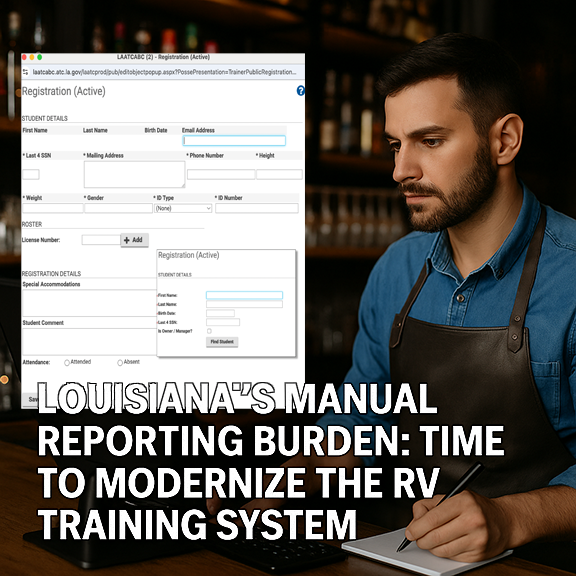
For approved Responsible Vendor (RV) training providers in Louisiana, the reporting process has become a time-consuming and inefficient task. What was once a straightforward class roster upload is now a tedious manual-entry system through the Louisiana Office of Alcohol and Tobacco Control’s (ATC) POSSE portal.
Every student must be reported one at a time, with providers required to enter:
- Full name
- Date of birth
- Gender
- Last four digits of their SSN
- Mailing address
- Height and weight
- Completion status
For training providers who serve hundreds—or even thousands—of students each month, this process is not just inconvenient; it’s a significant drain on time and resources.
Meanwhile, Other States Have Modernized
Louisiana is now lagging behind other states that have adopted more scalable, digital-first approaches:
- California uses a direct API for automated reporting.
- Oregon supports API reporting.
- Montana has a batch upload portal.
- Pennsylvania offers a provider dashboard with direct API connectivity.
- New York allows weekly roster reporting via email.
- Texas permits batch uploads by training date—allowing providers to submit multiple students in one go.
- Washington also allows streamlined uploads.
These systems acknowledge the real-world volume of students many providers serve and the need for scalable tools that support both compliance and operational efficiency.
Louisiana’s POSSE System Can Handle More—If Enabled
The irony? Louisiana’s current POSSE system is capable of batch uploads and API integrations. This platform, used by other agencies across the country, has all the technical capability needed to modernize the state’s reporting process.
The limitation isn’t in the system—it’s in how the system is being used.
Understanding the State’s Concern: Address Verification
One of the key concerns from Louisiana’s ATC appears to be verifying student addresses, since students are required to submit a state-issued ID or U.S. passport to be reported. This requirement is likely tied to confirming the identity and residence of the student before their certification is approved.
But many providers already have this covered.
Most online training systems today—including those used by many Louisiana-approved vendors—integrate with third-party address verification services during student registration. These tools validate U.S. addresses in real-time and can flag discrepancies before a student even begins their training.
So if the goal is to ensure address integrity, the technology is already in place—and being paid for by providers.
It’s Time to Work Toward a Smarter System
While concerns like address verification are valid, they should not prevent Louisiana from exploring more scalable solutions. A secure batch upload or API system can still incorporate data validation and verification—just as other states have done.
Streamlining this process wouldn’t just benefit training providers. It would also help the ATC:
- Receive more accurate data
- Reduce manual oversight
- Process student records faster
- Increase consistency across providers
Let’s Open the Conversation
Louisiana’s training providers are ready and willing to comply—but the tools we’re given should reflect the scale of our operations. NAHCT and its members welcome the opportunity to work with the ATC to improve this system—not only for efficiency but for better outcomes across the board.
If you’re a Louisiana training provider and want to share how the current reporting system is affecting your operations—or if you have ideas for improvement—email us at contact@nahct.org.
Together, we can modernize this process and return our focus to what matters most: delivering high-quality, responsible alcohol training.
—
National Association of Hospitality Compliance Trainers (NAHCT)
www.nahct.org
Training Providers United for Smarter Compliance